Google VP: The AI Shift Is Done and the Gap Between People Is Growing.Here's How to Stay Ahead — Silicon Valley Girl Podcast
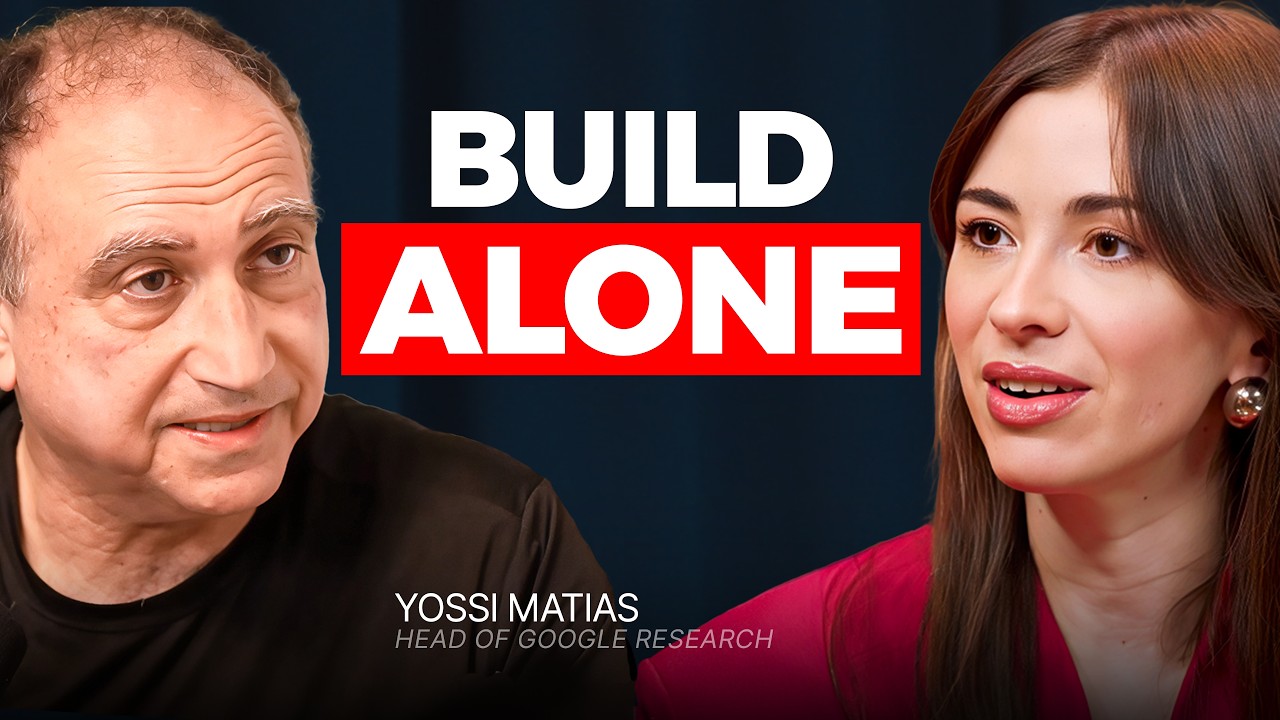
Yossi Matias is Head of Google Research with over 20 years at Google, where he built foundational products including Autocomplete, Google Trends, and Google Duplex. He has deep expertise in search, machine learning, and large language models, and actively leads hiring at one of the tech industry's most influential research organizations.
Marina Mogilko: Something shifted in 2026 that most people haven't really sat with yet. 36% of new companies are now solo founded, one person, no co-founder, no team. And this company is building things that used to require 12 people, 100 people. 5 years ago, that number was 23%. Demand for analytical and technical skills is up 20% in 2 years. And people who actually work with AI, not just use it, are pulling ahead visibly in terms of salary, in terms of how they're catching up with the world. And I wanted to understand what's happening so you can jump on these trends and maybe build a new career, or build a new business, or at least optimize your life. So, if you have things in your life that you wish, AI is changing how we do things and you need to understand this. In this episode, I will also talk to someone who represents a company I admire, Yossi Matias, head of Google Research. He built Google Trends, something that I use all the time. He built autocomplete. He's been at Google for more than 20 years and Google is one of the top companies leading this revolution. He doesn't do many interviews, so I'm really glad we did this one. Let's start with trend number one, AI agents. When most people think about AI, they think about asking for information in a chatbot. You ask something and answers. What's actually happening right now is different. Agents execute for you and you hand off tasks across your entire system, your email, your calendar, your research, your CRM, and you don't have to touch it. For example, I just set up an agent. It's really easy to do that with Perplexity computer, for example. I just automate everything. So, I'm keeping track of a couple of people on Instagram and I want to know what's going viral for them. So, Perplexity just goes, analyzes what's going viral, and every morning I get an email. What's going on in their accounts, how people are reacting, and I get a personalized script on a similar topic so I can make a video. And it's crazy. Stanford tracked that 35% of productivity gains is happening right now from using context-aware agents. That's the difference between a 4-day week and a 6-day week. What this means for your job is that the person who learns to set and run an agent isn't just faster. They are doing work that used to require two or three people. Trend number two, vibe coding. This one I personally find the most exciting and honestly a little wild. Vibe coding means describing in plain language what you want to build and having AI write the actual code. I have a person on my team who doesn't know how to code. She runs my LinkedIn. And she had an idea on Tuesday, on Thursday, it was a working product. And again, she doesn't know how to code at all. Yossi's team at Google has been working on something they call generative UI, where you describe what you want and in about a minute, you get a fully interactive application. Button, logic, interface, all in a matter of few minutes. Again, what this means for you, if you've been waiting to build something, a tool, a product, or a workflow, or if you have an idea, instead of just talking about this idea to your teammates, just go and build it. This barrier is gone. You talk to the app and you pitch a prototype. I think they're underhyped.
Yossi Matias: And here's why. So, first we should always keep in mind that what we're seeing today is not the future. We're just seeing today. And having been working for over a decade on search, we suddenly take the user intent and we try to give the best information. Now, with AI systems, we can actually understand much better user intent and let them actually express what we do. Now, vibe coding is a great example where people can now to be developed. And you can already everybody can now develop an application that previously required a team. We recently shared something that we call generative UI that enables you to actually for any prompt get a result out of. We have an experiment within our Gemini app called Dynamic View that gives the full interaction, fully interactive user interface in about a minute for any prompt that you ask. As if somebody was developing an application on your behalf. So, only you need to say what you'd like to learn about and it will sometimes even give all the buttons and emulation. And in fact, the technology is now available also in search AI mode.
Marina Mogilko: Trend number three, the skills that actually matter are shifting. The reflex most people have is AI is replacing jobs, so I need to become more technical to survive, learn to code, get a data science certificate, whatever. That's not wrong, but it's incomplete. Yossi hires constantly at Google Research, one of the most exciting places to be right now, and asked him directly, "What are you actually looking for right now?" And the answer wasn't a specific skill, it was the ability to think, adapt, and learn faster than technology changes. He said people need to relearn how to work even at senior levels because the tools shift every single month. But what that actually means in practice, the people pulling ahead aren't the ones who know more, they are the ones who know what to give to AI and what questions to ask when it gives back. So, if there is one thing you should be working on, it's actually your judgment. How do you know what is good and what is bad in your job? That judgment is learnable. You can work for somebody who has perfect taste and learn it from them. But almost nobody's deliberately practicing it, but that is exactly what's going to give you premium when you're looking for a job. I try to hire people who have taste, who can make strategic decisions, who know what's great for my content, and I care less about the technical skills because again, Claude is someone who knows everything about what's going on the world, but it can't make a judgment as good as a person.
Yossi Matias: Yes, so in a way, I remember I was asked, "So, how do you think things are going to change 5 years?" And I thought about it. On one hand, everything is going to be different. On the other hand, nothing is going to be different. I've heard that at Davos this year. In a way, we're humans. And what's motivation for what we're doing? It's not really to fulfill a particular predetermined task. We define our own ambitions, our own tasks. Same with learning. I remember the early days when suddenly Google was made possible for everybody to get facts and people said, "Well, wait a minute, what's going to happen for kids because we ask them to do homework and collect facts in library and now it's easy. Are they going to be lazy?" Well, no, because now this is a given, that's a tool. So, now we expect them actually to go to the next level. We expect them to synthesize. And now with AI, of course, there's another conversation, what is it going to do? And my prediction is that in fact, we're just going to uplevel what we expect. That's why I'm thinking about AI as an amplifier for human ingenuity. Now, what are we going to do with that? That goes back to the motivation. Why are we doing what we're doing? So, in a way, our lifestyle going to change? Definitely, but the basics are probably not going to change at all, which is about people working with other people, about solving important problems that they're excited about.
Marina Mogilko: And as a person who's constantly hiring, can you talk about the skills that you're looking for, both technical and non-technical?
Yossi Matias: One thing that I always thought is critical is the ability to think, the ability to adapt, the ability to evolve, the ability to actually think about problems and then try to solve them. Now, today these are more important than ever, of course, because technology is moving fast. People need to adjust their learning even no matter how experienced they are, there are new technologies. Engineers need to relearn how to use AI in order to be more productive and people are doing it. So, the ability to adapt, to learn, to have a strong foundation is more important than ever. So, for example, when I refer to AI as an amplifier of human ingenuity and the opportunity for every researcher to be able to use AI in order to actually ask bigger questions, it's important to also adapt and learn how to do that. If we really want people to be able to do the kind of roles that today we expect many more senior people who are much more senior to do, obviously we need them to learn how to do that much more quickly. The good news is the fact that to write a paper, for example, AI can give you very the kind of feedback that in the past you actually needed the attention of your advisor, perhaps, to do. So, I think we are—things are going to adapt in all of these dimensions. And I think humans are what we proved over the years is that we're extremely adaptive.
Marina Mogilko: Adaptive. Trend number four, AI is becoming invisible. Yossi called it ambient intelligence. The idea is that technology becomes powerful precisely when you stop noticing it. Think about Google Translate. When did you last think about how it works? You just use it. Or autocomplete, Yossi built that. Nobody thinks about autocomplete anymore, it's just expected. That's what's happening with AI tools right now. What this means for you is that as an employee, for example, I already expect beautiful presentations. I already expect that you do a very, very deep dive into what's happening in the business. All of these beautiful documents, they are a must because it takes a few minutes to generate them with AI. There's deep intelligence on the project. But again, it brings me back to this idea that beautiful reports, deep analytics, and everything is already expected just because it's so easy to do that. What we're paying premium for is creative decisions. Being on a call and explaining to the team the trajectory we're moving into. And that is something you can't just generate with AI. We're just talking about replacing tools, switching agents, rebuilding workflows. Founders do it all the time. But there is one platform almost nobody touches, their email, because that's where the revenue lives. Everyone's afraid to touch it. But what I've noticed talking to so many builders is that a lot of people are stuck on platforms they've already outgrown. The pricing doesn't scale, email and SMS live in separate tools, automations take forever to set up, and they stay not because they're happy, but because switching it does sound terrifying. Okay, now let's talk about the next AI trend. So, one notion that I've been quite passionate about for quite some time is what I would call ambient intelligence, which is that you have technologies that you just use. You don't think about them. They're becoming so available and so intuitive that you actually don't. You just assume they work.
Yossi Matias: Think about autocomplete, which I also had the privilege to develop with my team over the years in search. People just assume that you start typing, and it will just suggest to you. And I remember that in the early days, people were "So, what about this magic? Wow, how does it make a guess?" And today you just expect it to be the case.
And similarly, you can think about so many other technologies. Think about voice technology. The fact that now you can speak, and you expect what you're speaking to be understood. You can take text, you can listen to it. I remember actually working on these technologies in the early days. This was the aspiration. And now you just assume this is the case. Think about multiple languages. I still remember the day that one of my kids came from school and said, "Hey Dad, what's going on with your translate? That line, that sentence was not translated very well. It's actually quite bad translation." And I was thinking to myself, just a few years ago, having automatic translation of your page was science fiction, and he assumes this is just available.
Marina Mogilko: Trend number five, AI is rebuilding education. I absolutely love Google's Notebook LM. If you haven't used it for education yet, it's basically you upload a bunch of files, and then you ask it, "And now imagine it releveled for a 10-year-old who loves soccer, or gravity is explained using a free kick, or turned into a podcast, or an infographic that you can then post on LinkedIn." And those infographics do really well. Or you can make a whole video out of it and post it on YouTube. That's explanation for you, but also a lot of social media content. The model where you had one textbook, one level, same for everyone is 200 years old. AI is breaking it, and I think a lot about my daughters on this one. Kids who grow up with personalized AI tutors from age 5 are going to arrive at 18 with a completely different foundation than kids who didn't. That's a 10-year advantage. So, if you are reskilling now, make sure you use all of the advanced tools.
Yossi Matias: Education is highly important and is really poised to be transformed. We have a recent experiment of asking ourselves, can we reimagine the textbook? Instead, can we take a textbook and use AI in order to actually give it in different experiences that are going to be personalized and contextualized? So, for example, can I have an immersive experience? Can I take the text and make it immersive? Think Harry Potter. Can I make it conversational? Can I have a sketchbook with that? A podcast. Can I have it in a level that is suitable for the audience? So, for example, can I explain gravity to a 10-year-old who likes soccer, so that a textbook can actually be releveled to 10-year-old language, and give examples from soccer? The answer is yes, we actually have some experiments. And these are early days, so I expect that in the future it's going to be seamless, it's going to be just available to us. The trend that I'm seeing though, as a mom, is that now kids are expected to know how to read when they start school. Because back in the day, your kid goes to school, no letters, no numbers. Now they're like, "Actually we have the classes already reading, and they're 5 years old." And you're like, "Well, okay."
Marina Mogilko: Kids are already smarter, I think, than the older generation, and I think the next generation is going to be even smarter because they're going to have AI in their disposal.
Yossi Matias: Yes. Typically we had to, most people had to focus and learn a certain subject, and focus mostly on that one. And when they wanted to work across disciplines, they had to meet with other folks and try to somehow do that together. We're going to have everybody's going to have a polymath in their pocket. Trend number six makes me actually really very optimistic. Problems that were impossible are being solved in 5 years. I want to end on this one because I think it really changes how you hold everything else I just said. Your system builds flood prediction systems. 7 years ago, every expert they talked to said it was impossible. Too many variables, no clean data, no way to get to 7 days. Today, that system covers 150 countries and 2 billion people. Under 5 years start to finish. And we're getting better and better. Stanford economists called 2025 the AI harvest period. The experiments are done. What works is separating from what doesn't. The industries with the highest AI exposure right now are seeing labor productivity grow 4.8 times faster than the global average. And that's already measured. How productive we're getting is just crazy. So, when you're hearing AI can't do that yet, maybe now, but see what happens in 2 weeks. Stay curious about what AI can and can't do. We all heard about a guy creating a vaccine for his dying dog to treat cancer, and being willing to update your answer every few months, that might be the best underrated thing you can do for your career right now. When I say AI is an amplifier of human ingenuity, this is not only a prediction, this is a design goal. This is how I like us to build our systems, how I'd like us to see how we are helping you, our society to actually do that, how we're influencing education, so that our kids can actually grow into this future, and I'm quite optimistic about how we can actually have the next generation solve many other problems in the world.
Marina Mogilko: Yeah, because they have more to work with. I just wanted to ask you one last question. If somebody wants to remember one thing from this conversation, what is the mindset that they should adopt for 2026 to stay as positive as you are, and also relevant in the job market?
Yossi Matias: One exciting thing about using technology in research is that certain problems that seem impossible are not necessarily impossible. In fact, I've yet to see something that is impossible to tackle. Here's an example. One area that we're using AI quite a bit is on climate resilience—how to address natural disasters. One thing I learned at the time is that one area where we were not very helpful is in the area of flood prediction. Floods are causing thousands of deaths every year. Fast forward, we now have a system that provides flood predictions in 150 countries, covering 2 billion people, with predictions up to 7 days in advance. From what seemed to be impossible just 7 years ago, we have a system doing that. It's a real opportunity for innovation to create value.
On health care, we put out a model called Med-Gemini, which now has over 2 million downloads, which enables developers to develop their own applications with medical capabilities. In this video, six trends, real data, real examples from someone who has been building this for 20 years. Here's what I want you to take away from this: trends are happening regardless if you're with them or not. The people who are pulling ahead right now aren't necessarily the most technical, most hardworking people in the room. They are the most curious. They're the ones who are trying the tool, who are playing with things, reading something on X, watching some good YouTube videos, asking the question, updating their workflow, and moving on to the next thing. You already did that today. That's not nothing.
Marina Mogilko: If you're watching this and you're thinking "Marina, you're trying to not think with your AI"—I haven't even built a thinking buddy when it comes to AI, but I really want to have that option. Please subscribe to my email. This is exactly where I talk about these things, how we build them, and how they're working for us. And we give you the exact prompts and the exact files you can copy and paste into your workflows. Thank you so much for watching this video up to the very end. Don't forget to subscribe, and I'll see you very soon. Bye.