Gary Vee: The AI Opportunity Is Real — You're Just Looking at It Wrong — Silicon Valley Girl Podcast
Marina Mogilko: I need everybody to hear this. The middle class will be in trouble.
Gary Vaynerchuk: Do you think it's our last chance to build wealth?
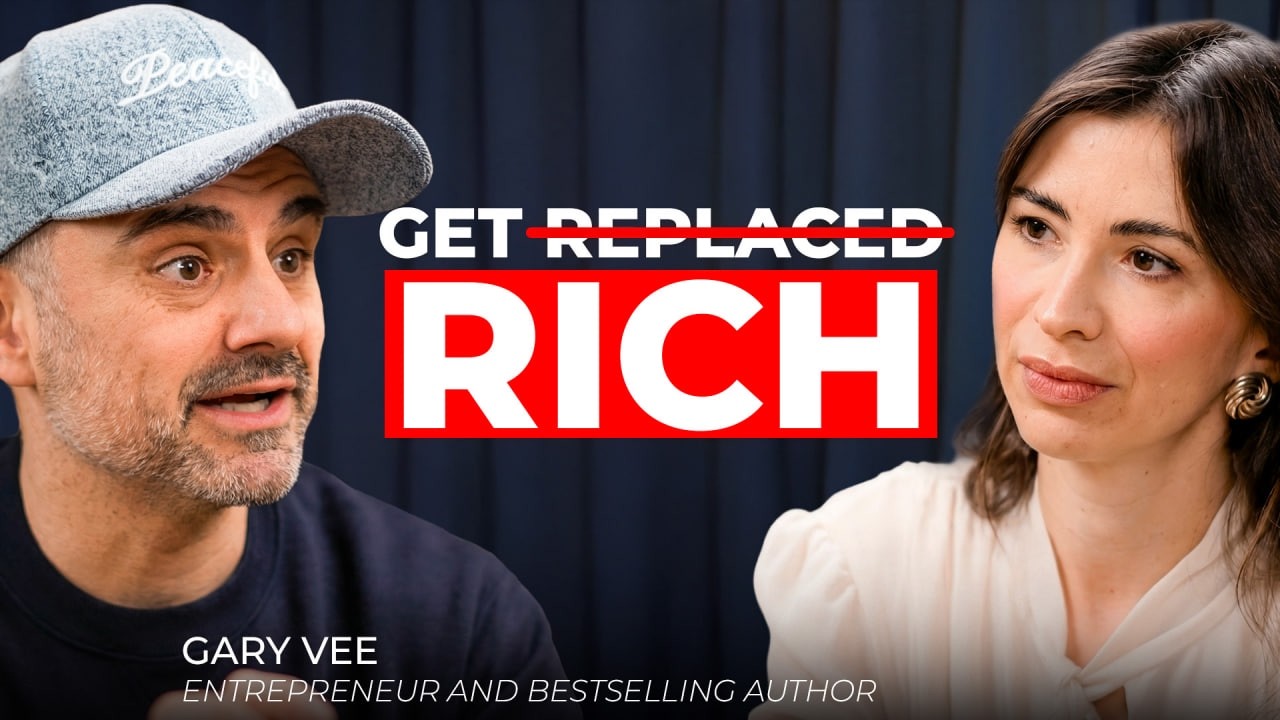
Marina Mogilko: It has the chance to create hyper micro wealth, but I think a lot of people are going to check out of this era. This is Gary Vaynerchuk, serial entrepreneur, best-selling author, and early investor in Facebook, Twitter, and Uber. He predicted TikTok, talking to computers, and the creator economy before anyone saw it coming. And in our lifetime's most unpredictable moment, I went straight to him for answers. What would you do if you have a laptop and AI?
Gary Vaynerchuk: I would build an app that's $5 to $50 a month, make unlimited organic content, and try to—
Marina Mogilko: For me as a person in Silicon Valley, I can totally see how Anthropic releases new lines of codes tomorrow and this business is done. Why would I start if it's already being automated?
Gary Vaynerchuk: Because everything you learn along the way will set up your next thing. What are you going to do? Lay down and cry? I'm asking you—
Marina Mogilko: In Chicago, I was there. I showed up. I didn't know what to expect and they went ahead, and I just battled and got through it. It was pretty cool.
Gary Vaynerchuk: Well, you do speak Russian which I'm glad you do.
Marina Mogilko: I actually want to talk about AI and what's happening. I've been watching you for eight years now. So I've been preparing for this interview for eight years, and what I noticed about you is that you're right at so many things. I remember you predicted TikTok and you're the reason I started TikTok. I have three million followers there because you were like, "You need to start TikTok." When you're looking at this AI era, do you think it's our last chance to build wealth right now?
Gary Vaynerchuk: That's a great question. One of the things I try to do is when I talk about things publicly, I've spent a lot of time thinking it through. And I've seen indicators of actual human action that show me an insight to the earliest preview of something I think will be at scale. So that's why a lot of my predictions have worked out. When I talk about our grandkids marrying AI robots, well, it's already happening in Japan.
Marina Mogilko: It is.
Gary Vaynerchuk: To me, that's not a long putt. That's just something that's happening in a part of the world that clearly to me is about human psychology, and so it's going to work. Your question is interesting because my intuition is it has the chance to create hyper micro wealth. The fragmentation of vibe coding and all this stuff and the stuff we're already seeing—kids building out products very quickly and having success. On the flip side, you're also alluding to the supercalers. When you look at what Meta and Microsoft and Google and Apple, and the biggest companies in China, you could see a winner-takes-all scenario where 12 or 13 companies dominate. My gut is that the economy and the consumer behavior is so large that there will be 25 companies that take so much. You look at Adobe and Salesforce and ServiceNow—SaaS companies are clearly coming out of an incredible 30-year run and now walking into a potential buzzsaw.
Marina Mogilko: I saw a headline yesterday. I don't know if it's true. It was busy, but maybe Claude just gave everybody a Bloomberg terminal for free. Those kinds of headlines—
Gary Vaynerchuk: Seem very real to me. They seem really natural, but it's almost like Meta or Anthropic or someone else is going to eat up more Bloomberg and ServiceNow and Salesforce. It's like the battle of the titans.
Marina Mogilko: And then over here on the scraps—well, the scraps actually might be quite big. It might be a social media-like era where all of us become vibe coders. Just like one of my great predictions in 2008 was that everybody would have a social media account when it did not seem like that.
Gary Vaynerchuk: Is everyone going to have a mini app that is monetizable because they themselves were able to build it without needing a developer for $500,000? I don't know. I believe that the middle will be in trouble, and the middle might be something like Vayner Media. But I have a feeling the separation of middle-class entrepreneurship could be real. The difference is the long tail could be quite at scale. Maybe even then creating this middle class. I don't know. If you put a gun to my head, I would say no, it's not our last chance.
Marina Mogilko: Okay. So we have a few years, right?
Gary Vaynerchuk: I think so. And let me take another counter just to build on this conversation. If it is our last chance and 79 companies make all the money, governments will get massively involved.
Marina Mogilko: Yeah.
Gary Vaynerchuk: And it may lead to a nirvana back to where we come from and where we're sitting.
Marina Mogilko: Could extreme capitalism mean a different version of socialism, coming back to the roots? Could a world where there's only 100 companies that make 80% of the money mean they'd then be forced to subsidize all the displaced workers? Do we live in a three-day work week environment with the other four days subsidized by the companies we work for? Do we have more leisure? Do we get more into the arts and family? And do we have side projects that make these micro pennies? I don't know.
Gary Vaynerchuk: So what if tomorrow everything crashes for you—Vayner Media, you lose your followers. What would you do if you have a laptop and AI?
Marina Mogilko: If I lost my reputation and my personal brand but kept my knowledge of how to make content on social—
Gary Vaynerchuk: I would build an app that's $5 to $50 a month, and I would make unlimited organic content on LinkedIn, Twitter, and TikTok and try to get customers.
Marina Mogilko: If you want to stay ahead in the AI era, I bring you the people who see what's coming next every week. Subscribe to this channel so you don't miss it.
Gary Vaynerchuk: That's a very interesting approach. I just talked to Bill Gurley, who's a legendary investor, and he told me, "You can't even imagine how many websites are there that are just passport photos that charge you $6." And yes, AI can do that, but because we're still so used to going to a website and paying, they're making tens of thousands of dollars a month, and we just don't realize it. For me as a person in Silicon Valley, I'm looking at all the businesses and I'm like, "Okay, I can totally see how Anthropic releases new lines of codes tomorrow and this business is done."
Marina Mogilko: That's not how consumers work.
Gary Vaynerchuk: He's right. It's not how it works. And in fact, I would argue what I do for a living and what I'm obsessed with actually explodes in this next era. It's all going to be about brand because you have to discover it. There. In 30 years by default, somebody would be like, "Oh, let me go to the main AI thing," and I don't need to. But there is going to be a long period of time here.
Marina Mogilko: Yeah, so there is this long tail. We still need to adjust. As humans, we take some time to adjust to new reality.
Gary Vaynerchuk: When you're a Silicon Valley girl and you even know who Bill Gurley is—
Marina Mogilko: You live in a different world than the 99.9% of people on earth who've never heard of Bill.
Gary Vaynerchuk: And that's opportunity for everyone who's listening.
Marina Mogilko: Correct.
Gary Vaynerchuk: Because transitioning to that era, together with small companies, small businesses, other people, educating them. I feel there is a lot of potential there. When you layer what I've been obsessed with over the last 20 years—which is there is an advertising and brand building ecosystem called social media that does not cost you money—and that's the point about AI apps. It really doesn't cost you money anymore to build something the way that I grew up. But the fact that you can actually get awareness, that you're one TikTok away from having people know who you are and building a platform, that's intoxicating. But do you have another worry talking about social media? I see a lot of AI content and we're getting flooded with so much content, so we're competing more. But also, there's another thing I'm always thinking about: what if social media platforms don't pay human creators? Why would they not just generate AI creators? It's much more personalized content, it's free, and they don't have to pay anyone.
Marina Mogilko: Well, platforms don't pay people.
Gary Vaynerchuk: Some of them do.
Marina Mogilko: No, they really don't. Meta doesn't pay people. TikTok doesn't pay people. They don't pay people. They are an open vessel that people go on and create for, and then businesses come and sit in between people that make content and people that consume content. Then the businesses advertise there or go to a creator and do a brand deal. Now, if you're saying why would L'Oreal go to you like they might today versus someone that looks kind of like you that they could even own—like a Mickey Mouse—
Gary Vaynerchuk: Exactly, and make a hundred videos versus one.
Marina Mogilko: They're going to do that.
Gary Vaynerchuk: Right now, there's stigma around that.
Marina Mogilko: And big companies are scared to go too deep into AI because there's pushback. But over the next 5 to 10 years, they will. Now, what they might use you for though is you might be one of the hundred faces they use, 99 of which they own the IP, but you're going to be able to do this. I think the rise of analog value is going to be extraordinary. So we're sitting in this world right now where people are doing stuff behind the scenes. For me, and I think you know this about me, I'm comfortable and good in both environments, both being, hosting a conference, having 25 people in this room right now while we do this. Brands are going to find incredible value in the analog world. Real life restaurants, real life studio podcasts, real life is going to explode. We're going to live in this barbell world—extreme technology, but extremely scaled. What we take for advantage is that's normal. Being outside, a pop-up shop, going to a sporting event, they're going to continue to increase in value. So the game's going to change. But I remind influencers, influencers are crying to me quite a bit. Gary, AI did this. I'm like, you took money from real celebrities. 20 years ago, none of us existed. All of that money went to Jennifer Aniston. If you were on Shark Tank, you were the only business people. I, Gary Vee, do not have a television show. I get comped for speaking fees and appearance fees greater than most of the sharks. That would have never been possible. So the world turns, things change. We just get too comfortable in our space.
Gary Vaynerchuk: Well, what's funny is when we're young and we're disrupting something, we like it. But when we're the one that gets disrupted, we don't like it.
Marina Mogilko: How are you adjusting your social media strategy?
Gary Vaynerchuk: Nothing because of what we just talked about. To me, I stay in my last book I wrote was called Day Trading Attention. I live in that environment. So if AI wasn't even happening right now, I'd still be focused on what I'm focused on—long form written content. So much more Substack, Beehive, LinkedIn, X, longer form content. I hired two full-time writers on my staff, journalists, who basically will listen to this entire interview and come up with 15 to 20 follow-up questions. That's why I needed someone who had a journalistic background because if it was just transcribing, I can AI that. And then we will create a first-person article about the barbell theory, why analog is on the rise. So a lot more written content.
Marina Mogilko: Interesting. And I feel like it's becoming so much easier because I remember four years ago I met someone from LinkedIn. They were saying you should be on LinkedIn. I'm thinking I can't write. I'm so bad at that. And then ChatGPT came around and my LinkedIn's growing crazy.
Gary Vaynerchuk: And I've always had ghostwriting infrastructure for my books because I've never been able to write, but I've always wanted it. It's funny. Every book I've written, everyone with my written content, people come up to me and say man, it sounds so much like you. It is fully me because it is truly transcribed from my words. I don't write differently than I talk because it's just transcription. Writing content, I'm incredibly focused on being remarkable on every platform—obsession to how to win Snapchat Spotlight, obsession to understand how to be great at YouTube Shorts, to make sure I'm feeding the LLMs of Gemini with my content.
Marina Mogilko: Why shorts, not long form?
Gary Vaynerchuk: Both. But shorts allows me to pump out a lot of how to, why content. There's a different dynamic there. So hyperfixation on the craft of the written word, the images, testing new formats. I call it pack platforms. I need to know everything that's happening on Substack, X, Pinterest, Instagram, TikTok, Shorts, all that—the algorithms within those platforms. What kind of content? What format? Is it a Reel? Is it full form like on LinkedIn? Right now, imagery is doing incredibly well. Video crushed last year. It's declining a little bit this month. Just understanding what's the algorithm within the platforms doing. Then see culture—what is happening in popular culture across everything. America is long fed from Black culture. Now we're seeing Hispanic culture, Korean culture impacting so much of US pop culture. Slang terms, quarter zip, Laboo's in then out, the Starbucks bear tumbler for 3 weeks then not, Stanley Cups then not.
Marina Mogilko: I love your passion when you're talking about this.
Gary Vaynerchuk: Well, pop culture is relevance. I can make one reference in here of something that's happening in popular culture and then for somebody listening, if they're also into the same thing, immediately we are connected. We are connected by being born in the same place. People look for it—we're tribal. We love sports, religion, because that's what it is. Cultures. You and I met immediately. We're just from the same place. It is what it is. But by the way, when I walk outside right now, if somebody's wearing a Jets hat, they're immediately my brother.
Marina Mogilko: So I think pop culture, especially in B2B environments, is very misunderstood. But even in B2C environments, the biggest consumer brands I work with in my day-to-day, I think they underestimate pop culture.
Gary Vaynerchuk: Even creators. I'm talking to so many big brands and they've never advertised with creators. I'm just surprised. Let me pause here for a second because what we've been talking about connects directly to something my team has been actively testing. Running a media company, the operational load never stops because you prep for podcast episodes. You have to push content to multiple platforms and somewhere in between a million documents land in your inbox waiting for your decision. That's our day-to-day. And a few weeks ago, my team started testing something that's been changing how we handle it. That's Axio Work. What I appreciate most about it is that you can build a full secure agent team for your business, not just one AI. Each agent has its own identity, intelligence, tools, skills, and persona. You can create as many as you need, fully custom, and they work in parallel with a pre-built library of connectors already set up. Gmail, Shopify, HubSpot, social platforms, nothing to configure. Here is what that actually looks like in practice. My team runs three agents: a strategist, a producer, a CPO. The CPO leads the agent team, keeping operations aligned and making sure nothing falls through the cracks. The producer works under the strategist. Content decisions are always backed by data before anything goes into production. Each agent has a defined role, a clear reporting line, and they coordinate directly with each other without me in the middle. You can also set up recurring scheduled tasks that run automatically every day without anyone touching them. Set a time, set a task, and it runs. For example, every morning at 10 a.m., my CPO agent sends the whole team a briefing with the latest industry news. No one has to ask for it. It just lands in the chat. Axio Work is built by Alibaba—26 years of B2B infrastructure behind it. That's what makes it different from a generic tool. Right now there's a limited time offer: 2 weeks of unlimited access to top tier models, including Claude 3.5. The link is in the description. So you're saying you're not running faster because of AI, just doing whatever you're doing.
Marina Mogilko: I'm saying that I don't have a different social media strategy right now because of AI per se. If I wake up from a coma right now in 7 years and everything's different, it will not take me long to get back on the bike and be successful because I'll just spend a hundred days paying attention to where is everyone paying attention to. Oh my god, AI changed everything. We're back to reading newspapers. Okay, I'm going to make newspaper ads. It's not complicated. The thesis is simple. Understanding how to be good at the thesis is hard.
Gary Vaynerchuk: Has your hiring changed because of it? How many people do you have now?
Marina Mogilko: You know, it's funny you say that. We at Vein, so I have many different companies, but the biggest one I run is Vayner X, Vayner Media, and there's Chuck Media and the Tomorrow Group. Three very large advertising agencies, all of which do something pretty similar. We're exploding, and I'm having this very challenging game. I was in Seattle yesterday, as you heard before we went on here. I met with the three biggest companies that are headquartered there. All of which are like, "We want to do more with you. We want to do a lot with you." Two that are already working with us. A third that wants to collaborate with us. So the demand of customers is exploding. I still need an extraordinary amount of human beings because it's a human-based business. Yes, I understand that AI can do the job of other things. It is not lost on me that a hundred people can now do the work of four hundred people. I'm just worried about the output wars of the future. What if you're competing with somebody that has four hundred and you have four hundred. You cut two hundred and they still have four hundred. And in our world, you and I, we're like, "Ah, we're outflanking them. We're going to be better. We're going to make more ROI. We're going to." But what if they weaponize those four hundred people with the same tools that we weaponize our two hundred people? In my world advertising, if my four hundred people now make twenty-seven thousand ads and your two hundred people make sixteen thousand ads, for whatever human element is there, and I understand it doesn't work that way, but there's this concept of is AI a shield and a sword and a gun versus rocks in a war. You would think two hundred will beat four hundred, but what if the four hundred also have shields and swords? And so there's something here that I haven't fully figured out. I'm definitely being cautious. We are definitely first and foremost attacking things that do not have value. For example, if you're a project manager at Vayner Media and your sole job, every project manager comes in different shapes and sizes, but if you're the kind of project manager who only takes notes, that is how you define yourself, that person has already been asked to do more.
Gary Vee: Was there something that you transformed with AI within your team that blew your mind? You're like, "Oh my god."
Marina Mogilko: My mind has not been blown since I had a lot of friends in Silicon Valley talking that machine learning was getting better and better and I was thinking maybe I'm impressed on how fast everything is happening, but I'm at a point where yes, everything in between is just a step to that. That's where I think we're going.
Gary Vee: It's normal for you.
Marina Mogilko: To me, basically, here's where my head's at. I'm going to take my phone and be like, build this app. I want to do this. Enter. Done. So if I'm already there, everything in between is just a step to that.
Gary Vee: Anything you transformed in your process or you just started executing by yourself?
Marina Mogilko: Probably the biggest thing that happened to me is I am an anthropologist pop culture strategist. So having that level of thinking power with me that I used to rely on search and just digging around the internet, that was profound. I was flying here yesterday and I was playing with Claude Skills, which is a skill that you can build that executes for yourself. It was preparing me for this interview and I was thinking this is fascinating. I feel like I'm a superhuman with all these tools because Perplexity every day sends me stocks to buy. Claude Skills does my research. It's just fascinating.
Gary Vee: But I also think it feels like a superhero today. The same way I felt with the iPhone that first year. I bought the iPhone the day it came out, especially in New York because of Wall Street and any big city, there was Blackberry obsession and I felt like a superhero that first year because I could go on the internet for real, not the way the Blackberry people could. And that gave me a hyper advantage. I would go and do something and I could look something up before I went on stage or went into a meeting and that was powerful in a way that I didn't have with my laptop even though that used to have that capability. It was just so fast. You feel like a superhero with Claude, Perplexity, GPT, Meta's infrastructure starting to get very impressive. To remind everybody who's listening, your grandmother in the office did not have internet, did not have AI, did not have social media, did not have an office to your point, did not have mobile computing, did not have a computer in the office, did not have internet.
Marina Mogilko: Yeah, I mean this is just technology.
Gary Vee: But do you feel that we're in this period of time and we are the one percent that are grasping technology? Do we need to run faster to make the most out of it?
Marina Mogilko: Well it depends on the human ambition. I think a lot of people are going to check out of this era. Let's talk about Silicon Valley. I have a lot of Silicon Valley friends who were all in, going so hard during early web, twenty five, twenty six, twenty seven, twenty eight, blogging, podcasting, and then social, who made enough money and are in a different part of their life now who have given nothing about AI and blockchain.
Gary Vee: Everyone wants to build wealth. This I feel is such an opportunity and it's unique for the next ten years. I feel like we have this year.
Marina Mogilko: Yes.
Gary Vee: And then it's basic for everyone.
Marina Mogilko: I don't think that makes sense that you think that and I understand that. I think you and I will see each other in ten years and be like, man, you were right. Just as much as it looks like AI creates a winner takes all world, I have a funny feeling it's not going to.
Gary Vee: Because don't forget there is the human element. It's going to take too much time. You know what people don't do well? Hang with me for a second. Let's play this game. Let's take that point. Let's say ten companies won everything.
Marina Mogilko: Do you literally think that eight billion people are going to be like, "Yeah, that's awesome."
Gary Vee: No.
Marina Mogilko: Okay.
Gary Vee: And governments would not agree.
Marina Mogilko: So that's it.
Gary Vee: It's just funny to hear this from you because you're the one like, "Hustle, do this."
Marina Mogilko: People don't take my sentence in its totality. Hustle. Go hard. If you complain and are a crybaby and you don't realize that accountability can help you, hustle if you like it so much that you would do it if it was free. I would build businesses if it was free. Meaning it made me happy. It's my joy. I build companies the way people like to go golfing and cooking and watching movies. It's more fun to me. You know, it's so funny. We put on a pedestal someone who's a philosopher or a great reader. Someone who reads books all day in the room is a real thinker and writes. Oh, so noble. That's what I do. I just do something with it on the other side. So I think hustle if it makes you happy. One could argue that the extreme opposite of hustle is what I also do. I mean, the more you know me, the more you would realize I'm incredibly detached from my career or my public persona. I'll make it very blunt. I don't give a damn about Gary Vee or my Vayner Empire. I do not think it makes me better than anyone. Who cares if I'm good at business? Some people are good at skiing. Some people are good at singing. Some people are good at writing. It just happens to be something I'm good at. I have my self-worth wrapped up into who I show up as a human to people in my life. That I'm a nice person. That when I
Gary Vee: Was that a switch ever in your life?
Marina Mogilko: Absolutely not. It was ingrained in me by my mother and my circumstances and my DNA.
Gary Vee: What would you say to someone who thinks their worth is tied to their results and that makes them very anxious in this era?
Marina Mogilko: I would say I understand. It's a very common human trait. I would also say that almost everybody I know on earth that is wrapped up in that metrics mindset has incredible anxiety and anxiety sucks.
Gary Vee: How do you separate yourself from that? But I feel like it's easier to say for you because you have all the millions of followers already and millions of dollars.
Marina Mogilko: You're saying that because you don't know me. If my friends that have known me my whole life will tell you that I have the millions of followers and dollars because I've always been this way. That's the reason. It's not that I have an incredible relationship with losing.
Gary Vee: I like it. What do you tell yourself when you lose?
Marina Mogilko: That I sucked and that was funny and let's not try to do that again and what could we do next? I love the challenge. You know, I was the kid when I was losing in sports or ping pong or pool. I loved playing again. I didn't think me losing in front of my sister or mom meant that I was lesser then. I played outside of this short-term validation framework. And I also was incredibly structured to not struggle with peer pressure in high school and in college when so many of my contemporaries did everything for validation amongst their peers. I did not. And that was just tremendous parenting, luck of the draw with DNA and the circumstances I grew up with.
Gary: What are you telling your kids?
Marina Mogilko: Well, they're not me. I'm telling I'm trying to leave deposits on that, but they're growing up in a very different environment. Now, luckily, my children share a lot of mine and my ex-wife's DNA and are also a little bit cocooned. My 17-year-old daughter does not live her life for her friends or boys attention. So, she's cooking with gas. My 13-year-old son also, he's I would have said three years ago, he's already starting to develop this. DNA is a real thing. And then when you have parents that are conscious and are pushing you on the right things, the only core thing they're for sure they have different is environment. I don't have this ideology for my children to be exactly like me or just like me or they need to be hungry like I was. I want them to be happy and lack anxiety like I was.
Gary: Any tip how to teach that? I have a four-year-old and a six-year-old and I feel like they really rely on what other kids think of them. What do you tell your kids?
Marina Mogilko: I pounded that narrative into my kid verbally. As young as that I would tell my children like people making fun of you, people saying you're awesome means nothing. How do you feel? What do you like?
Gary: Yeah, and learning not to react to positive things and negative.
Marina Mogilko: The reason I can deal is I today have 95% validation, 5% skepticism and push back. It's the goat emojis in my Instagram posts that I have to not pay attention to. Not the you suck Gary or you got lucky or you're a snake oil. To me it's not hearing the accolades. I'm telling you that that's where the lack of anxiety comes from. I don't need to have a house or a plane or a third home or a Nobel Peace Prize or 40 million followers or an exit to impress Bill Gurley. I don't need that. It is not what my life is about. I like it, but I feel like I'm an athlete who wants to be great on the field, but off the field that is not the man that I think I am. I feel like everybody should learn this type of mindset especially now because also I have this question from my team who read your piece AI splits people into architects and masons.
Gary: Yes.
Marina Mogilko: And half of my team thinks they're masons but they have the ability to become an architect. So how do you deploy that mindset when you know you're losing right now because AI is replacing you? But how do you go to the next step of your career utilizing this mindset that I don't need external approval and this mistake of failure isn't me?
Gary: How do you lose 25 pounds when you know you're not feeling great? I'm asking you.
Marina Mogilko: Well, it's either or. You die sooner than if you don't.
Gary: Yeah, there's that outcome. But how do you do it? I'm not saying what the outcome is and you're right about that.
Marina Mogilko: I don't know. I don't have this problem so I can't relate. My husband has this problem. He loves sugar.
Gary: Yeah, me too.
Marina Mogilko: So he just feels worse and for him it's stopping sugar completely. That what works. Completely.
Gary: But it's hard.
Marina Mogilko: It is.
Gary: I go through patches where I also cut it out. I'm your husband. I have the same issue. Sugar is the real bane of my existence. Let me tell you how I stopped drinking soda for every beverage 13 years ago. I also hired a full-time person 12 years ago. There would have been a man in here right now to make sure I didn't take a sip.
Marina Mogilko: For one year.
Gary: I took an extreme measure of babysitting to get me into the discipline. He suffocated me to then get into patterns to get into the discipline and then it became my norm. If you are a mason and you want to become an architect, you can cry about it. You can stop and start. We all stop and start in health, in wellness, in work. But you need to for it to become your actual pattern. It becomes your norm. To your point, sometimes it's cold, but it starts here first. If I had that whole team right now, I'd be like, listen, you can do it. You have to believe that. If you don't, what are we going to do? It first starts mentally and then it starts physically. You need to start using these tools to help you think better, to put in the work. You need to start reading. You need to start doing this. You need to start hanging out with these people. You need to start taking from your leisure, which you're using to get an escape from your concern and you need to allocate some of your leisure time into more work. You have to go to the gym and eat better. That starts with your mind, but then it has to happen with your actions. And then you just have to stay in that conversation. The reason the world is so tight right now is we've stayed in a negative conversation for 10 years. My newsfeed is not politics. My newsfeed is not telling me that the world is going to my newsfeed doesn't tell me that my parents had it better than me. You're in control of your algorithm. You're in control of the people that you spend time with. Look at all the people that are listening to this right now. These people chose to follow you and listen to you. Some are here because this is the first time they're listening to you because they follow me knowing enough of your platform and definitely knowing my platform. These are people that are choosing offense. These are people that are choosing optimism. These are people that are choosing to try to figure it out.
Marina Mogilko: Yeah.
Gary: That same person could have a twin sibling who right now we're on a this is a Saturday morning that you and I are filming this who might be watching Netflix this morning which is lovely and you should have leisure. But why are they watching it? Are they watching it because they have a little side dish of leisure and enjoyment? That's beautiful. But if it's their main course and they're doing it because they had an anxious week and they're devastated that they have to go back Monday, now I'm concerned. Does that make sense?
Marina Mogilko: Totally.
Gary: To me, leisure and escapism needs to be side dishes and a moose bushes, not the main meal.
Marina Mogilko: Yeah.
Gary: When it's the main meal, you are escaping your actual life that isn't going well.
Marina Mogilko: Gary just told me that AI is splitting people into architects who build things and masons who do things. And most people don't even know which side they're on yet. Future proof is my weekly newsletter where I break down exactly what architects are doing right now that masons aren't. The tools, the moves, the mindset shifts. Link is in the description. Please subscribe. It's absolutely free and I talk about a lot of practical things there. Let's talk about people who are watching who are immigrants because I have a lot of immigrants watching. You came to America at age three. I came when I was 25. For someone who arrives today, what is the first thing they should be doing?
Gary: I think it's a framework. It's funny we used curiosity. I think it's a framework of self-awareness, humility, and curiosity. So self-awareness is if you come from Guatemala, Poland, South Korea and you're here in the US or you're an American who's deciding I don't know one of those people which you're allowed and you're moving to Sweden or you're going from India to England or England to Argentina. No matter what shift you're making, a lot of people listening here will move to other countries because of jobs. Their wife got a big executive position, they're the entrepreneur and she just got a big job and now you're moving to Portugal. When you are new in an entirely new country as an immigrant, I think there's three things to rely on. Number one is self-awareness. Who are you? When I came over, you know, I was a kid, but the older generation, these people were engineers in the Soviet Union and they were literally cleaning toilets.
Marina Mogilko: Yeah.
Gary: That was the second part. Humility. Humility is a superpower. I'm aware that my humility does not show up on the internet because that is not the way I communicate. But I will tell you that in my real life behind the scenes, it is one of the beacons of my success. I've never gotten away from the kid that immigrated. With all the stuff on paper, I still don't think I'm better than. I don't think I have earned the ability to not put in the work or to be gracious or to be kind or whatever it might be. So I would say self-awareness. Who are you? What are you good at? You have to then see if that's available to you in the country. Sometimes it is, sometimes it's not. Nuclear engineers from the Soviet Empire literally had to clean toilets because America wasn't just giving them jobs. And then they had to build themselves up and they owned a pharmacy later on. You know how it all worked out, right?
Gary Vaynerchuk: Humility. I know that you were the big dog in India, but maybe here in Poland that doesn't work. Or you were amazing, you were a good creator in America, but now for some reason you live in Indonesia and you don't have that many followers in Indonesia. Humility. And then back to curiosity. For me, I would just if again face got ripped off like that John Travolta Nicholas Cage movie. Reputation lost. I find myself in Peru. This is where I'm going. Who am I? I have good people skills. I have work ethic. I know how to buy and sell. I know consumer behavior. Next, humility. I'll go work at a store as a cashier if I have nothing. If I have nothing and then curiosity at night after I get back from the store, what's going on here in Peru? Where's my angle? What can I do? What can I sell? So, that is my advice, that emotional framework. And then you have to act on it. Ego is just pure insecurity.
Gary Vaynerchuk: Ego is just pure insecurity. Posturing, trying to be the big dog, that just means you're scared. That means you're not good internally. Thus, you must render your peacocking to trick everyone around you.
Marina Mogilko: And that places limits on what you're doing because you're trying to feed your ego versus build something.
Gary Vaynerchuk: I'm not mad at that. Do you know that I'm not mad at people that are like that? I'm sad about it. I wish they could like themselves. Do you know how many shortcomings I have? Plenty. We all do.
Marina Mogilko: Okay. If someone's watching right now and they're like, "Okay, I'm going to work on all of this, but I really want to build in this AI era." What do you think is the biggest opportunity right now?
Gary Vaynerchuk: It goes back to the last question. There's a million of them. I just don't know the person that's listening right now. For example, if you're overly charismatic, the biggest opportunity is to go live streaming on the internet and then drive all of that audience to an AI app that you built that's 10 bucks.
Marina Mogilko: Before it's automated by AI. Have you seen in China how they're doing this live? They just basically put an item in front of the camera and it's automated and there is this AI person already wearing it or showing it. It was crazy.
Gary Vaynerchuk: That's right. Including the influencer is AI. It's me and I put your face on me and I'm a woman selling makeup.
Marina Mogilko: But when I think about this, why would I start if it's already being automated?
Gary Vaynerchuk: Because everything you learn along the way will set up your next thing. What are you going to do? Lay down and cry.
Marina Mogilko: I don't know, find something else. Because I'm talking to a lot of entrepreneurs, they're in this stage. They're like, "Oh, I really want to do this." But then it's just going to be taken away by a big company.
Gary Vaynerchuk: You're too young for this. But in 2005, 6, 7, 9 in Silicon Valley, the same thing was being said. Why would I start this? Google's going to copy it.
Marina Mogilko: You're just talking to fake entrepreneurs. Real entrepreneurs are willing to lose. Real entrepreneurs know that the two years they work on something was two years of them working on something that sets up their next thing. Real entrepreneurs don't know how to do anything else. Real entrepreneurs don't lay down and cry. Real entrepreneurs don't say, "I'll just go get a job." Real entrepreneurs are real entrepreneurs.
Gary Vaynerchuk: That goes back to knowing who you are.
Marina Mogilko: Correct. And by the way, let me say something right now. This is actually a beautiful segue. I need everybody to hear this. If you're listening right now and you think you're an entrepreneur, but these last three minutes of this talk are triggering some weird feelings, do you know how awesome it was to be number seven at Facebook? Do you know how incredible it was to be number nine at Tesla? Do you know how epic it is to be number 34 at LinkedIn, Microsoft? How cool it is to be a podcaster. This concept that I grew up, entrepreneurship wasn't even a word, being a businessman was not cool, and then I ironically was part of the movement that kind of made this thing cool. But I have been talking for 10 years: please, it's only cool if you are that. It's not cool to be a teacher if you're not a teacher. It's not cool to be anything if you're not actually that.
Gary Vaynerchuk: That is a good ending. And I have a few questions that are rapid fire. What are your top three favorite AI tools that you use daily?
Marina Mogilko: GPT, Claude, and honestly Meta's just a couple weeks in, but it's really good.
Gary Vaynerchuk: Do you use it for your Instagram?
Marina Mogilko: I feel like they have access to all the data, so they can do better analytics than anyone.
Gary Vaynerchuk: Correct. What's your favorite prompt?
Marina Mogilko: My favorite prompt is me intuitively feeling something that's happening in culture. I'll give you one right now. Does the baggy pants movement for men have another domino to fall? Like I will ask that.
Gary Vaynerchuk: That's a very advanced prompt. So you know exactly what's happening and you're trying to predict what's next.
Marina Mogilko: Correct. That is almost everything I'm doing.
Gary Vaynerchuk: College degrees in 2026. Yes or no?
Marina Mogilko: For 50% of the people that are listening right now, yes. They need that degree to do the profession legally in medicine. For the most creative and entrepreneurial people, yes, if mommy and daddy paid for it. Because 18 to 22 as a full-fledged vacation to hang out with other 18 to 22 year olds is a lot of fun. But for 18 to 22 year olds that are taking on substantial debt who are creative and entrepreneurial, that doesn't make sense.
Gary Vaynerchuk: One industry to stay away from?
Marina Mogilko: None. Everything's in play. Look, betting your whole life to be an admin that's a mason, not an architect is bad. An admin that's an architect is huge. I'm going to hire people that have the power of 13 admins for me and she or he is going to sit at the top of that and I'm going to pay that person a fortune to make my life effective.
Gary Vaynerchuk: What's the most misunderstood thing about AI right now?
Marina Mogilko: The counter to whatever anybody's thinking. So for the people that are delusionally thinking this is the greatest thing ever, the counter is the negatives that are going to happen. And for the people that think everyone's out of their minds about China and Perplexity and Anthropic and America and Russia and there's going to be nine countries and nine companies, the counter to the extremism of what people think.
Gary Vaynerchuk: Thank you for your positivity and energy. It's really charging. What you're saying gives energy to people versus just lay down.
Marina Mogilko: And I think that doesn't sit in some blind optimism or even the great parenting that I was given. It sits in historics. It is historically true that we were scared of electricity and it wasn't. It's historically true we got off the farms. We did so much more. Humans are great. I know we're told that we're not, but 99.999% of us are either neutral or great. And if I am wrong, here's why I'm this way. If I'm wrong, I promise you, you're not going to worry about your job. If I'm wrong, we're all dead anyway. So, either I'm right that you should choose practical optimism and there's going to be a million opportunities for you if you go inward and work on you, or if unfortunately I'm wrong, then who cares? I'll see you in heaven. It's not practical to be pessimistic and cynical. It is not practical.
Gary Vaynerchuk: You heard Bill Gurley's name enough times today that I think you know what's coming. In our conversation, Bill shared a mindset shift that's worth every minute of your time. I put the video right here on the screen. And let me know in the comments if you came from this episode with Gary.